
This post may contain affliate links. As a I earn from qualifying purchases (if applicable).
If you’ve ever wanted one of those “did that just happen?” nature moments with your kids—where everyone gets quiet for a second and looks up in total awe—Santa Cruz in monarch season delivers.
Most people know Natural Bridges State Beach as the classic spot to see overwintering monarch butterflies. And it is. It has the official Monarch Butterfly Natural Preserve, an easy trail into the grove, and you’ll often find volunteers/docents around to help you spot the butterflies (because yes, they can blend in shockingly well).
But here’s the extra tip that feels like a local secret: you can also see monarchs near the lighthouse at Lighthouse Field State Beach, just down West Cliff Drive. Monarchs winter there too, clustering in eucalyptus and cypress in the cooler months.
So if you’re trying to plan a family-friendly outing that feels special without being complicated, this is the move: start at Natural Bridges, then stroll (or drive) down West Cliff to Lighthouse Field.
The quick answer: When and where to go
Best season
Monarchs typically arrive around mid-October, peak in late November to early December, and begin migrating out by mid- to late January (sometimes into February).

Two top places along West Cliff Drive
- Natural Bridges State Beach (Monarch Grove / Monarch Trail area) – the most reliable, easiest for first-timers, and the place where you’re most likely to find docents/volunteers.
- Lighthouse Field State Beach (near the lighthouse / Point Santa Cruz) – another consistent overwintering area and a gorgeous family walk with ocean views, surfers, and wildlife.

Why Santa Cruz is such a great monarch spot for families
Because it’s not just “go stare at a tree.” (Though, honestly, when the tree is covered in butterflies, it’s kind of amazing.)
You get an easy mix of:
- short walks that work for kids
- free nature education (especially at Natural Bridges)
- big “wow” payoff without a long drive
- and plenty of “backup fun” nearby—beach time, tide pools, playground stops, snacks on West Cliff, and surfer-watching.
And the settings are beautiful. Lighthouse Field (also known as Point Santa Cruz) sits on one of the last open coastal headlands in a California urban area and marks the northern boundary of Monterey Bay. It’s known for surfers, sea lions on offshore rocks, birds (including the rare black swift), and wintering monarchs.
Natural Bridges Monarch Butterflies – State Beach: the “official” monarch experience
What makes Natural Bridges the main stop
Natural Bridges has a dedicated Monarch Butterfly Natural Preserve. The park describes its Monarch Grove as a temporary winter home for monarchs, with thousands overwintering in some years.
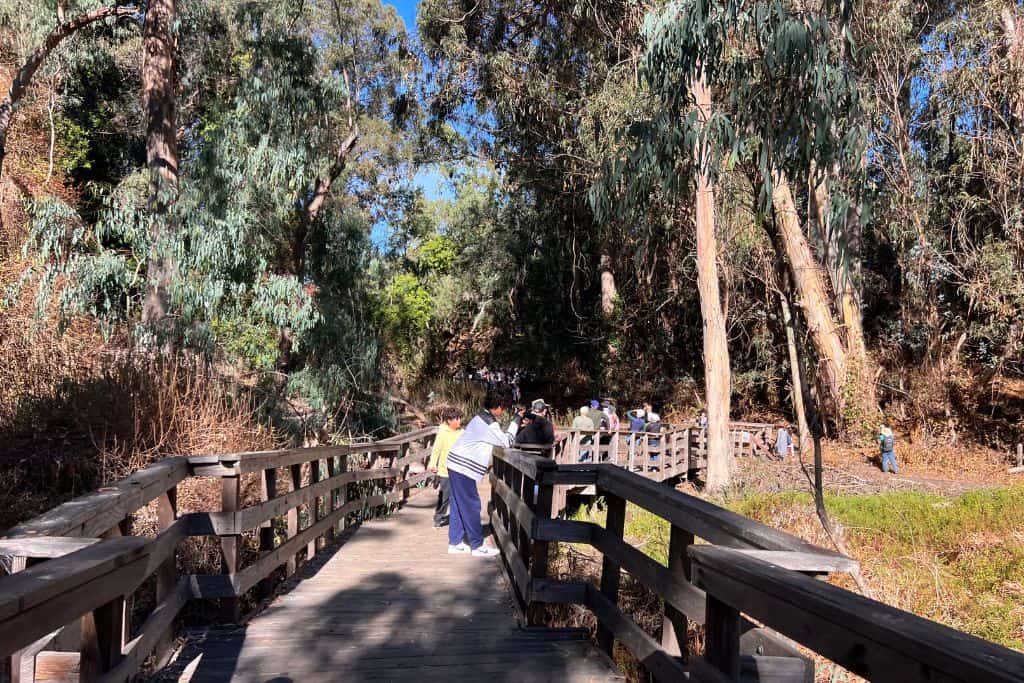
A big perk for families is that the monarch viewing area is easy to access. Xerces describes Natural Bridges as accessible via the Monarch Trail—a shaded wooden boardwalk with a gentle grade leading to an observation deck. That’s exactly the kind of “yes, we can do this with kids” detail that matters.
Parking + hours
The Monarch Grove Trail is open for self-guided visits during park hours, and one recent local guide notes park hours as 8am to sunset, with $10 parking.
If you’d rather avoid paying, Xerces notes you can sometimes find free parking on nearby streets, but the paid lot is usually the simplest option with kids (especially if you have snacks, layers, and a stroller).
The best time of day to see them
Here’s the trick that makes you feel like you “know what you’re doing”:
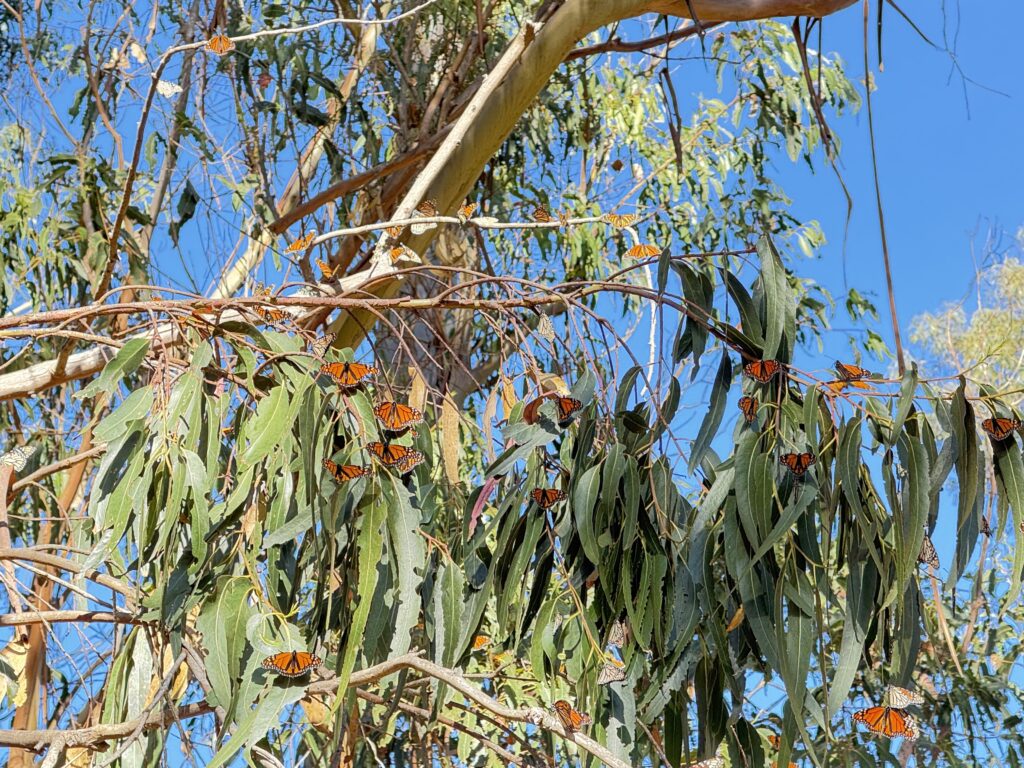
- Cool mornings: Monarchs often cluster together in the trees, hanging like leaves. That’s when you’ll get that iconic “tree covered in butterflies” look.
- Warmer afternoons: When it warms up, they may fly or move toward nectar areas. (This can be super fun for kids—more movement—but clusters can be smaller.)
A docent tip shared by Visit Santa Cruz County: monarchs generally need about 55°F to fly. When temps are below that, you’re more likely to see them clustered.
“We can’t find them”—how to spot monarch clusters fast
If you’ve ever taken kids to see wildlife, you know the moment: everyone is excited for approximately 90 seconds… and then the questions begin.
A few simple ways to make this easier:
- Look for “dead leaf clumps.” Clusters can look like brownish leaves from a distance.
- Use your phone camera zoom like binoculars.
- Ask the volunteers/docents if they’re there. Volunteers are often available in the grove to help visitors locate clusters.
- Don’t rush. Give it 10 minutes. Once your eyes adjust, you start seeing them everywhere.
My favorite almost secret spot Lighthouse Field State Beach: your “less crowded ” spot that makes the day feel complete
It’s also a great option if Natural Bridges feels crowded that day.

Why Lighthouse Field is worth it (even if you only see a few butterflies)
Because it’s one of the best easy coastal walks in Santa Cruz. You can:
- watch surfers near Steamer Lane
- spot sea lions on offshore rocks (bring binoculars if you have them)
- let kids burn energy on wide open paths
- and keep an eye out for monarchs wintering in the grove areas

California State Parks notes Lighthouse Field is free (no day-use fees), open 6am to sunset (parking lot 8am to sunset), and dogs are allowed on leash—including on the beach.

Xerces also specifically lists Lighthouse Field State Beach as a recommended public place to view overwintering monarchs, describing it as a Monterey cypress and eucalyptus grove that often hosts sizable displays.
Where to look for butterflies at Lighthouse Field
The simplest parent answer: look for eucalyptus and cypress grove areas, and scan branches the same way you do at Natural Bridges—searching for clustered “leafy” patches.
Numbers vary year to year (and even week to week), but Lighthouse Field is regularly included in Santa Cruz County’s monarch viewing conversation for a reason.
The perfect family plan: Natural Bridges + Lighthouse Field in one outing
This is the easiest way to structure it so it feels like an “adventure” but doesn’t become a “why did we think this was a good idea” day.
Morning: Natural Bridges monarch grove (cool temps = clusters)
Start at Natural Bridges while it’s still cool so your kids get the full monarch “city in the trees” effect.
Let it be simple:
- walk the Monarch Trail / grove area
- take photos
- let the kids “be the spotters”
Midday: snack + reset
This is the moment to do what parents do best: snacks, water, bathroom break, layer changes.
Afternoon: West Cliff walk + Lighthouse Field
Head down West Cliff to Lighthouse Field. You’ll get ocean views, lighthouse vibes, and a second chance to spot monarchs in another overwintering area.
On warmer days, you might see butterflies moving more, which can be a lot more exciting for kids than “look at that tree.”
What to bring (so everyone enjoys it)
You don’t need much, but a few small things make a big difference:
- Layers (Santa Cruz can feel chilly in the shade, even on sunny days)
- Binoculars or your phone zoom
- Snacks + water (this is non-negotiable with kids)
- A small blanket if you want a “sit and watch” moment
- Patience for 10 minutes while your eyes adjust to the grove
Monarch manners: how to visit responsibly with kid
Monarchs are overwintering—they’re conserving energy. The best viewing is respectful viewing.
A simple family rule set:
- look, don’t touch
- stay on trails/boardwalks
- keep voices calmer in the grove
- don’t shake branches or try to “make them fly”
And if you want to go one step further, Natural Bridges has volunteer programs and docent training tied to the monarch season. also encourages learning about and supporting habitat where you live.
Frequently asked parent questions
“What if we don’t see any?”
First: it happens. Monarch numbers fluctuate and clusters can be camouflaged.
Second: that’s why pairing Natural Bridges with Lighthouse Field is great—you’re stacking your odds, and the outing is still beautiful even if the butterflies are sparse.
“What time is best?”
If your main goal is clusters, go in the morning when it’s cooler. Monarchs often need around 55°F to fly; cooler temps increase clustering.
“Do we have to pay to see them?”
- Natural Bridges usually involves a parking fee (noted as $10 in a recent local guide).
- Lighthouse Field is free (no day-use fees).
Final thoughts: the kind of “small” trip your kids remember
This is one of my favorite types of family outing because it doesn’t require tickets, reservations, or a perfect schedule. You’re just showing your kids something real and beautiful—migration, seasons, wildlife—right in your backyard.
Start at Natural Bridges for the classic monarch grove experience and docent support. Then head to Lighthouse Field for the coastal walk, the lighthouse views, and a second chance to spot overwintering butterflies in another grove.
And if you go, don’t rush it. Give everyone time to look up, adjust their eyes, and have that moment where the “leaves” suddenly become butterflies.